2025/2026 Business Trends: AI, Sustainability, and the New Workforce Paradigm
2025/2026 Business Trends: AI, Sustainability, and the New Workforce Paradigm
As the calendar turns toward 2025–2026, a convergence of forces is reshaping the business landscape with unprecedented speed. Generative AI is no longer a speculative technology—it has become a creative engine accessible to anyone with an internet connection. E-commerce is projected to surge by nearly half a trillion dollars globally, while remote work has permanently altered how companies think about talent and geography. At the same time, skills-based hiring is challenging the primacy of traditional resumes, sustainability is moving beyond marketing slogans into circular business models, and immersive technologies are moving from gaming into industrial prototyping and workforce training.
These trends are not isolated. They form a coherent shift: from product-centric, linear models toward experience-driven, human-centric enterprises. The companies that understand this deeper logic—and integrate subscription pricing, brand partnerships, enhanced employee benefits, DEI programs, and a focused appeal to Gen Z consumers—will build the resilient, adaptive organizations of tomorrow.
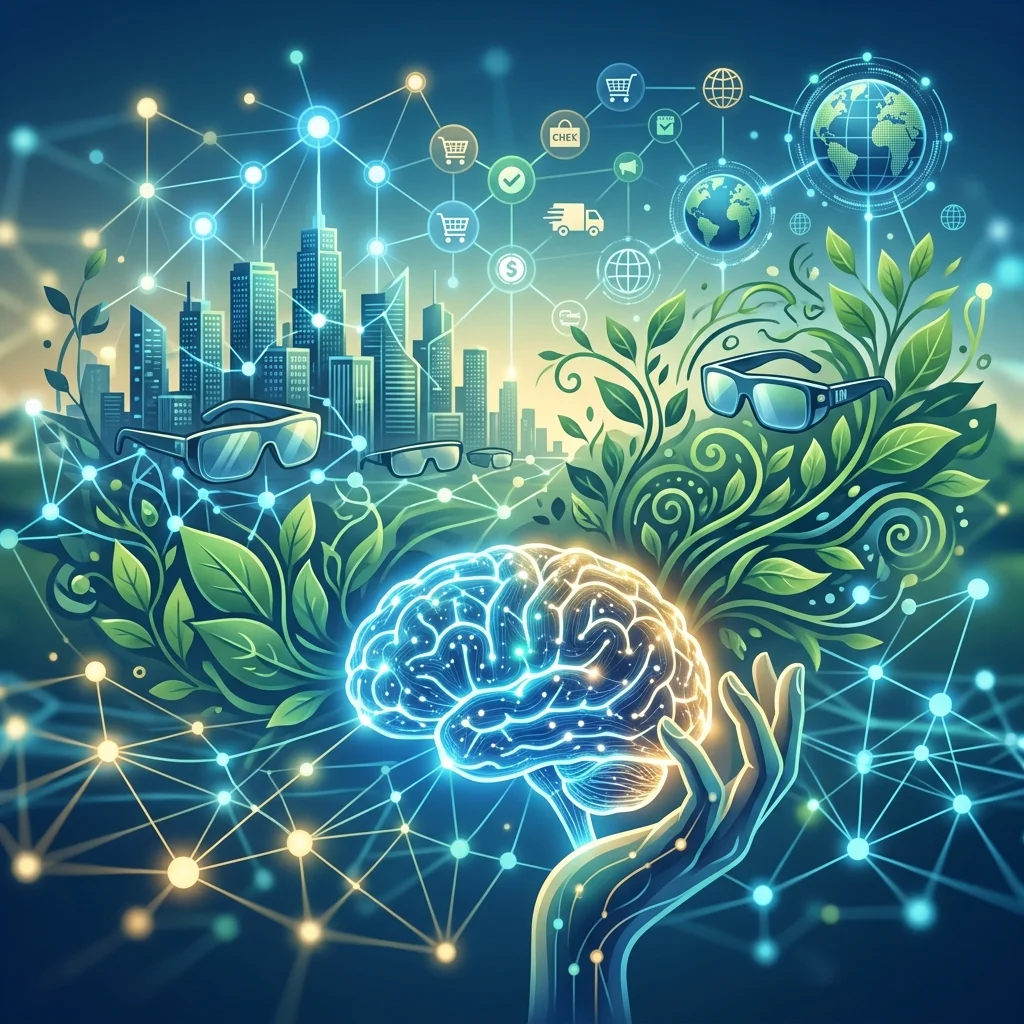
[IMAGE: Abstract digital landscape with interconnected nodes representing technology, people, and nature. In the foreground, a glowing AI brain merges with a human hand, while a distant city skyline blends with green leaves and AR glasses. E-commerce icons and globe symbols float in the background. Clean, futuristic style with blue, green, and gold gradients. No text or watermark.]
The AI Revolution: From Automation to Creative Democratization
Generative AI tools—ChatGPT, Midjourney, Adobe Firefly—have fundamentally lowered the barrier to content creation and design. Small businesses and startups that once relied on expensive agencies can now generate marketing copy, product visuals, and even code with a few prompts. This democratization is not merely a cost-saving measure; it redefines who can participate in the innovation economy.
According to McKinsey’s 2024 research on AI adoption, companies that integrate generative AI into their workflows see an average 15–20% increase in productivity for knowledge workers. IBM’s Global AI Adoption Index similarly reports that 42% of large enterprises are now actively deploying generative AI, with a further 30% exploring pilot programs. Yet the most transformative effect may be on human roles. As AI handles routine production tasks, workers are freed to focus on strategy, creative judgment, and relationship-building—exactly the soft skills that employers increasingly value alongside automation.
This shift aligns with a broader technological trend identified by Forbes: the rise of immersive technologies such as augmented reality (AR), virtual reality (VR), and mixed reality (MR) for prototyping and training. Instead of building physical mock-ups or sending employees to off-site training centers, companies now use VR to simulate assembly lines, AR to overlay digital instructions onto real equipment, and MR to allow remote experts to guide onsite technicians. Boeing, for example, has used AR to reduce wiring production time by 30% and error rates to near zero.
Yet with great power comes great governance. Harvard Business Review recently cautioned that the rapid deployment of generative AI creates new risks—from data privacy violations to hallucinated outputs that can mislead decision-makers. Organizations must establish frameworks for responsible AI use, including human-in-the-loop validation and transparent attribution of AI-generated content.
[IMAGE: Split-screen image: left side shows a person using Midjourney to generate a product design, right side shows a prototype in AR glasses.]
The Future of Work: Remote, Skills-First, and Inclusive
Remote work, once a pandemic-era stopgap, has solidified into a permanent feature of the labor market. LinkedIn data shows a 35% rise in remote job postings since 2020, and many companies now operate fully distributed teams spanning multiple time zones. This social trend is redefining organizational structure: instead of anchoring talent to a physical headquarters, businesses can access a global pool of expertise. It also demands new management competencies—digital collaboration, asynchronous communication, and trust-based performance tracking.
Perhaps the most disruptive shift, however, lies in how companies evaluate candidates. The 2023 State of Skills-Based Hiring Report by TestGorilla found that over 70% of respondents believe skills-based hiring is more effective than reviewing resumes. Indeed, a growing number of employers now use pre-employment assessments, work sample tests, and portfolio reviews rather than relying on degrees and employment history. This approach not only widens the talent pool—it reduces bias. TestGorilla’s data indicates that skills-based hiring increases the diversity of new hires by up to 30%, particularly benefiting candidates from underrepresented backgrounds who may lack traditional credentials but possess proven abilities.
To support this new paradigm, reskilling has become a strategic priority. Coursera and IBM certification programs offer stackable credentials that allow workers to update their skills on demand. Companies such as Walmart and Amazon have launched internal learning platforms to prepare employees for roles that may not yet exist. The result is a workforce that values continuous learning over static qualifications.
At the same time, employee expectations are rising beyond salary. Enhanced benefits—including mental health days, student loan repayment assistance, and paid parental leave—have become key differentiators in attracting and retaining talent. DEI programs (diversity, equity, and inclusion) are no longer optional; they are proven to improve innovation, employee satisfaction, and reduce turnover. According to a McKinsey report, companies in the top quartile for gender diversity on executive teams are 25% more likely to outperform their peers on profitability. Those with high ethnic and cultural diversity are 36% more likely to outperform.
[IMAGE: Diverse team collaborating via video call with skill badges floating above each participant – clean, modern office setting.]
Sustainable Growth: Circular Economy, Trust, and Compliance
Sustainability has evolved from a public relations strategy to a regulatory and competitive imperative. Consumers—particularly Gen Z—are demanding transparency and accountability. A 2024 Statista survey found that 68% of global consumers consider sustainability when making purchasing decisions, and 52% have stopped buying from brands they believe are deceptive about their environmental impact.
The response is a shift toward circular economy models, where waste is minimized, products are designed for longevity and repairability, and materials are recovered and reused. Companies like Patagonia have long championed this approach with their Worn Wear program, but now mainstream players such as IKEA, H&M, and Apple are implementing take-back schemes, modular designs, and refurbishment programs. This is not merely altruistic—it creates cost savings and new revenue streams. According to the Ellen MacArthur Foundation, a circular economy could generate $4.5 trillion in economic benefits by 2030.
Regulation is accelerating this transition. The European Union’s Green Deal, which includes the Corporate Sustainability Reporting Directive (CSRD) and the proposed Anti-Greenwashing Directive, requires companies to provide detailed, audited disclosures on environmental and social impacts. Non-compliance carries significant penalties, but forward-thinking companies see compliance as a competitive edge. When done authentically, sustainability reporting builds trust with investors, customers, and employees.
Brand partnerships are emerging as a powerful tool to amplify sustainable offers without diluting authenticity. For example, IKEA partnered with the non-profit World Wildlife Fund to source more sustainable cotton; PepsiCo has teamed up with Plastic Bank to capture plastic waste before it reaches oceans. Such collaborations allow brands to leverage complementary strengths, expand reach, and share the costs of sustainability investments.
Statista projects that U.S. e-commerce revenue will surpass $1.5 trillion by 2026, a growth of nearly $500 billion from 2023 levels. Much of this growth will be driven by Gen Z and younger Millennials, who are not only the most sustainability-conscious demographics but also the most digitally native. To capture this market, businesses must integrate sustainable practices into every touchpoint—from packaging to shipping to product life cycle information. Subscription models, already popular in software and entertainment, are expanding into consumer goods (e.g., Loop’s reusable packaging service), offering a way to reduce waste while creating recurring revenue.
[IMAGE: Circular flowchart showing product lifecycle from raw material to design, use, repair, and recycling – with green arrows and data icons.]
Converging Forces: Subscription, Brand Partnerships, and the Gen Z Imperative
Behind the three major trends of AI, workforce transformation, and sustainability lies a common driver: the shift from owning to accessing, from transactions to relationships, and from products to experiences. The subscription economy is now a $1.5 trillion market, according to Zuora’s Subscription Economy Index, and it is expanding beyond media and software into everything from furniture (Herman Miller’s “Lending Library”) to cars (Volvo’s Care by Volvo).
Brand partnerships, when executed strategically, allow companies to cross-pollinate audiences and create offerings that neither could deliver alone. For Gen Z, who value authenticity and community, collaborations that align with their values—like the Adidas x Parley partnership using ocean plastic—resonate far more than traditional advertising.
Finally, DEI programs and employee benefits are not just HR initiatives—they are competitive levers. A workforce that reflects the diversity of its customer base is better positioned to innovate and understand shifting demands. As remote work enables hiring across geographies, companies that invest in inclusive cultures will attract top talent who have multiple options.
Conclusion: The Logic of Integration
The trends of 2025–2026 are not a menu from which leaders can pick and choose. They form an interconnected system. Generative AI enables the creative work that fuels personalized subscription offers; remote work and skills-based hiring create a talent pool capable of executing sustainable, technology-driven strategies; and Gen Z’s preference for ethical, transparent brands drives the entire cycle.
Businesses that treat these trends in isolation risk fragmentation: a company with cutting-edge AI but a toxic culture will lose talent; one with strong sustainability claims but no skills-based hiring will struggle to find the expertise to deliver on those promises. The winners will be those that integrate AI, sustainability, and workforce transformation into a cohesive operating model—one built on trust, adaptability, and a genuine commitment to human and planetary well-being.
As we enter the second half of the 2020s, the question is no longer whether to adapt, but how comprehensively. The data is clear. The tools are available. The path forward requires not just innovation, but integration.