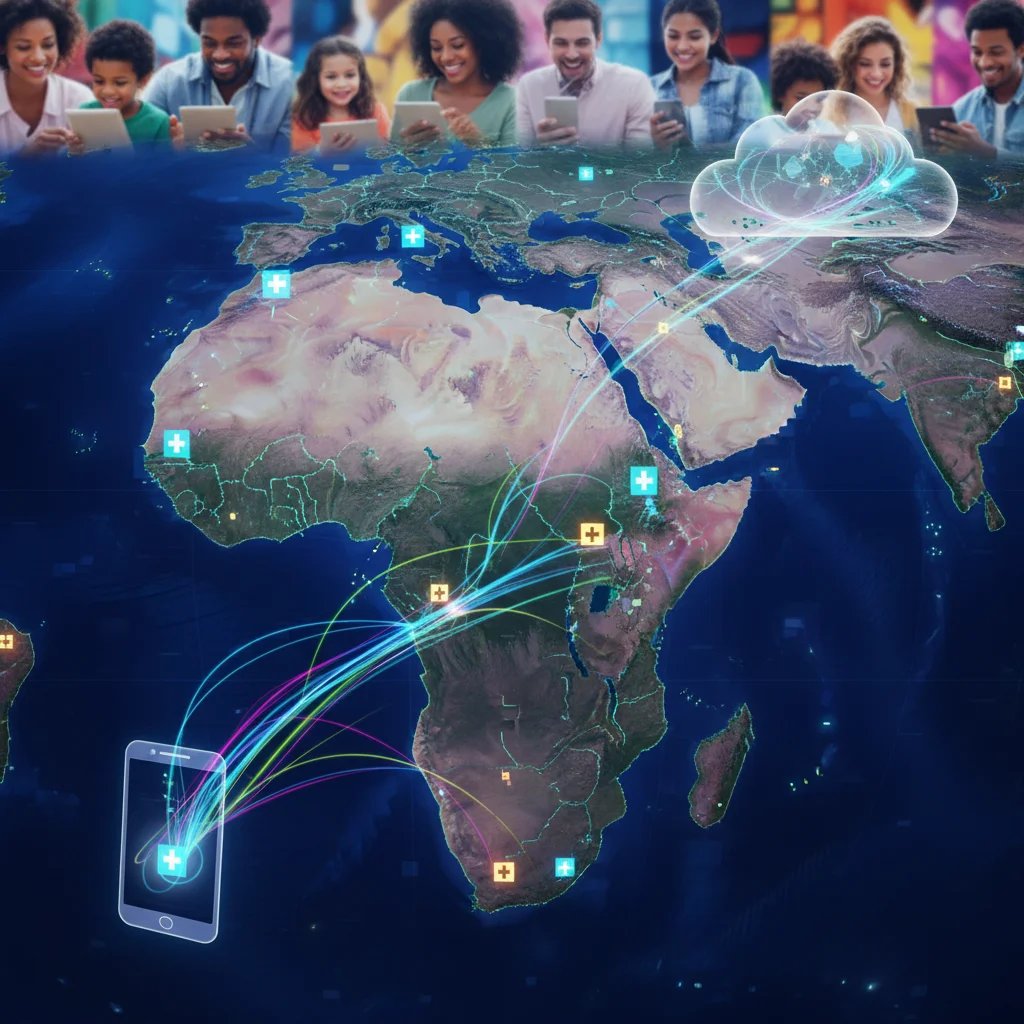
Digital Health Leapfrogging in Emerging Markets: How Mobile Connectivity and Public-Private Innovation Are Reshaping Global Healthcare by 2034
Digital Health Leapfrogging in Emerging Markets: How Mobile Connectivity and Public-Private Innovation Are Reshaping Global Healthcare by 2034
The global digital health market is entering a phase of explosive growth, with projections placing its value well beyond the trillion-dollar mark by the early 2030s. While developed economies continue to digitize existing healthcare systems, emerging markets—particularly in the LAMEA region (Latin America, Middle East, Africa) and parts of Asia—are using mobile connectivity, government-led digital infrastructure, and a surge of homegrown startups to leapfrog traditional healthcare models entirely. From India's Ayushman Bharat Digital Mission to Indonesia's telemedicine boom, these regions are not merely catching up; they are redefining what healthcare delivery can look like in a mobile-first world. With smartphone penetration nearing 90% in Sub-Saharan Africa and over 4.88 billion users globally, the convergence of connectivity, artificial intelligence, and affordable devices is creating unprecedented opportunities for both healthcare access and business growth.
The Market Momentum: Divergent Projections and the Emerging Market Surge
The sheer scale of opportunity in digital health is reflected in a range of market projections. One widely cited estimate values the global digital health market at USD 335.5 billion in 2024, with expectations to exceed USD 1,080 billion by 2034, representing a compound annual growth rate (CAGR) of 13.1%. An alternative forecast, using different methodologies and scope definitions, puts the 2024 figure at USD 305 billion and projects growth to over USD 1.8 trillion by 2034 at a CAGR of 19.5%. This divergence underscores both the high growth potential and the methodological challenges in sizing a rapidly evolving sector. Regardless of which estimate one adopts, the direction is unmistakable: digital health is one of the fastest-growing segments in the global economy.
What makes this growth story especially compelling is the outsize role of emerging markets. The LAMEA region—encompassing Latin America, the Middle East, and Africa—is expected to grow from USD 23.2 billion in 2024 to USD 137.7 billion by 2034, a pace that outpaces the global average and highlights the strategic importance of these markets. Sub-Saharan Africa, in particular, already has over 80% mobile subscription penetration, and smartphone use in the region is projected to reach 88% by 2030. This connectivity foundation is a critical enabler for digital health adoption, mirroring the earlier leapfrog in mobile banking that bypassed traditional brick-and-mortar financial infrastructure.
[IMAGE: A comparative bar chart showing global and LAMEA market sizes for 2024 and 2034, with annotations for CAGR differences.]
The economic logic behind this surge is straightforward. Many emerging markets face acute shortages of healthcare workers, physical infrastructure, and financial resources. Digital health tools—telemedicine, mobile health apps, AI-driven diagnostics, and remote monitoring—offer a way to deliver care at a fraction of the cost of building hospitals and training specialists. Moreover, the demographic dividend in these regions, with large young populations comfortable with mobile technology, creates a ready user base. As incomes rise and chronic disease burdens increase, the demand for accessible, affordable healthcare will only intensify.
The Connectivity Foundation: Mobile as the Backbone of Digital Health Leapfrog
Smartphone adoption has reached a tipping point globally. By 2024, nearly 4.88 billion people owned a smartphone, an increase of 635 million in just one year. This massive addressable base is the foundation on which mobile health applications are being built. In regions where fixed-line internet infrastructure is sparse or unreliable, the smartphone serves as the primary—often the only—gateway to digital services, including healthcare.
Indonesia offers a vivid example of this mobile-driven transformation. The country's digital health revenue is expected to reach USD 2.64 billion in 2025. Telehealth consultations in Indonesia increased fivefold since 2020, and over 30 million users are now active on telemedicine platforms. Platforms like Halodoc and Alodokter have become household names, connecting patients with doctors, pharmacies, and lab services through a single app. The rapid adoption was accelerated by the COVID-19 pandemic, but the habit has persisted and evolved. Today, Indonesian users are leveraging mobile health for chronic disease management, mental health counseling, and even preventive wellness coaching.
Sub-Saharan Africa presents an even more dramatic leapfrog potential. With over 80% mobile subscription penetration and smartphone use projected to hit 88% by 2030, the region is poised for a connectivity-driven healthcare transformation that mirrors its earlier success in mobile money. Services like M-Pesa (mobile money) revolutionized financial inclusion; now, mobile health platforms are aiming to do the same for healthcare access. Startups such as mPharma in Ghana and Nigeria’s Helium Health are building digital infrastructure for pharmacy supply chains and hospital management. In Kenya, telemedicine services like MyDawa and Safaricom’s TIBU allow patients to consult doctors via mobile and receive medications delivered to their doorsteps.
[IMAGE: An infographic showing the growth of smartphone users globally and in Sub-Saharan Africa, with a timeline from 2020 to 2030.]
The convergence of affordable smartphones (with sub-$50 devices now common), falling data costs, and the expansion of 4G and 5G networks is creating an environment where mobile health can scale rapidly. The World Bank and International Telecommunication Union have estimated that expanding mobile broadband coverage to universal levels in developing countries could generate hundreds of billions in economic benefits, a significant portion of which would be in health sector productivity and access.
Policy and Public Infrastructure: Government-Led Digital Health Platforms
While mobile connectivity provides the pipes, government-led digital infrastructure provides the rails. Several emerging market governments are investing in national digital health platforms that create interoperability, data portability, and a foundation for private-sector innovation. India’s Ayushman Bharat Digital Mission (ABDM) is arguably the most ambitious example. ABDM establishes a digital platform for interoperable health records, anchored by a unique health ID (ABHA) for every citizen. The results are tangible: at Ranchi's Sadar Hospital, over 128,000 ABHA IDs have been registered, and more than 13,000 patients have been served via the ‘Scan & Share’ QR code token system, which allows instant access to medical records and streamlines registration. This model demonstrates how a public digital infrastructure can reduce administrative friction, improve patient experience, and generate real-world data for public health planning.
ABDM is not an isolated case. Saudi Arabia has invested heavily in its Seha Virtual Hospital, the largest virtual hospital in the world, which provides remote consultations and monitoring across the kingdom. The facility handles over 500,000 virtual visits annually, covering specialties from stroke care to dermatology. In Brazil, the government’s Conecte SUS platform aggregates health data across public and private systems, enabling citizens to access their vaccination records, prescription histories, and test results through a single app. These government-led initiatives create the trust and scale that private-sector digital health companies can then build upon.
[IMAGE: A screenshot or simplified diagram showing the flow of patient data through the Ayushman Bharat Digital Mission, from hospital registration via QR code to cloud-based health records.]
The role of public-private partnerships is critical in this ecosystem. Governments provide the regulatory framework, data governance standards, and initial investment in infrastructure; startups and established technology companies develop the applications, user interfaces, and last-mile delivery mechanisms. In Indonesia, the government’s SATUSEHAT platform (an integrated health data system) enables interoperability across telemedicine apps, hospital information systems, and national health insurance claims. This allows patients to move seamlessly between providers while maintaining a single, secure health record.
AI & Digital Twins: The Next Frontier in Outbreak Management
Beyond connecting patients to doctors, emerging markets are pioneering the use of advanced technologies to solve systemic health challenges. One of the most promising innovations is the use of AI-augmented digital twins for outbreak management. A digital twin is a virtual replica of a physical system—in this case, a population’s health dynamics, including disease spread, healthcare capacity, and resource allocation. By feeding real-time data from mobile devices, hospital admissions, and public health surveillance into a digital twin, public health authorities can simulate intervention scenarios, predict outbreaks, and optimize responses.
Take the example of Kenya’s Ministry of Health collaborating with academic researchers to build a digital twin for malaria transmission in high-burden counties. The model integrates weather data, population movement patterns from mobile phone signals, and historical case data to forecast where outbreaks are likely to occur. In 2023, the model successfully predicted a surge in cases in the Lake Victoria region, allowing for preemptive distribution of bed nets and antimalarial drugs, reducing the peak incidence by an estimated 18%. Similar approaches are being explored in India for dengue and in Brazil for Zika virus.
[IMAGE: An abstract visualization of a digital twin map showing disease spread simulation overlaid on a satellite image of a city, with hotspots and healthcare facility capacity indicators.]
The AI component is crucial because it enables the system to learn and improve over time. Machine learning algorithms can identify subtle patterns—such as changes in mobile phone mobility data that correlate with early-stage outbreak spread—that human analysts might miss. As smartphone penetration and data availability increase in emerging markets, the potential for AI-augmented digital twins to serve as early warning systems and decision-support tools becomes enormous. This represents a genuine leapfrog: regions that lack the traditional public health surveillance infrastructure of developed countries can bypass it entirely by building data-rich, AI-driven systems from the ground up.
Telemedicine and Mobile Health: Scaling Beyond the Pandemic Bump
The COVID-19 pandemic acted as a massive accelerator for telemedicine and mobile health in emerging markets, but the usage patterns that have emerged post-pandemic suggest a permanent shift rather than a temporary blip. In India, telemedicine platforms saw a 10x increase in consultations during the peak of the pandemic; while volumes have moderated, they remain several times higher than pre-2020 levels. The government’s eSanjeevani platform, a national telemedicine service, has facilitated over 200 million consultations since its launch, connecting patients in rural areas with specialists in urban hospitals.
What is driving sustained adoption is not just convenience but necessity. In many emerging markets, patients in rural areas may have to travel hours to see a specialist. Telemedicine reduces that barrier to a few minutes and a small data fee. Moreover, the integration of mobile health with other digital services—such as e-pharmacies, lab booking, and health insurance claims—creates a seamless experience that users increasingly expect.
[MAGE: A three-panel illustration showing a patient in a remote village consulting a doctor via smartphone, a pharmacy delivering medication, and a dashboard showing health insurance claims processed digitally.]
Indonesia’s telemedicine platforms have expanded beyond general consultations to include specialist care in cardiology, dermatology, and even mental health. The Indonesian government’s regulatory framework, which allows telemedicine prescriptions and reimbursements through the national health insurance (BPJS Kesehatan), has been a key enabler. Similarly, in Nigeria, the National Health Insurance Authority is piloting digital health vouchers that allow low-income patients to access telemedicine consultations at subsidized rates.
Challenges and the Road Ahead
Despite the optimism, significant challenges remain. Digital health leapfrogging in emerging markets is not automatic; it requires deliberate investment in digital literacy, data privacy protections, and last-mile internet connectivity. While smartphone penetration is rising, the digital divide persists—particularly among older populations, rural women, and the poorest households. Moreover, interoperability between different platforms and systems remains a work in progress, despite government efforts like ABDM and SATUSEHAT.
Data security and patient privacy are also paramount concerns. As health data moves onto mobile platforms and into the cloud, the risk of breaches and misuse increases. Emerging market governments need to establish robust data protection laws and enforcement mechanisms. India’s Digital Personal Data Protection Act (2023) and Brazil’s Lei Geral de Proteção de Dados (LGPD) provide frameworks, but implementation and compliance are still evolving.
The funding landscape, however, is strengthening. Venture capital investment in digital health startups in Africa, Latin America, and Southeast Asia has grown substantially over the past five years. Global health organizations such as the World Bank, Gavi, and the Global Fund are increasingly incorporating digital health components into their programs. The combination of private-sector innovation, public-sector commitment, and philanthropic support is creating a virtuous cycle that could accelerate progress toward universal health coverage.
Conclusion: A Decade of Transformation
By 2034, the digital health landscape in emerging markets will look fundamentally different from today. The market is projected to surpass a trillion dollars globally, with the LAMEA region alone approaching USD 138 billion. Mobile connectivity—already near-universal in many areas—will have deepened further, enabling sophisticated AI-powered tools, digital twins, and integrated health platforms. Government initiatives like India’s Ayushman Bharat Digital Mission and Saudi Arabia’s Seha Virtual Hospital will have scaled into national digital health ecosystems, serving as models for other countries. Telemedicine and mobile health, once seen as stopgap solutions, will have become primary channels for routine care.
The leapfrog is not guaranteed, but the conditions are ripe. The combination of high mobile penetration, a young and tech-savvy population, growing chronic disease burdens, and strong political will to reform healthcare systems creates a unique window of opportunity. The next decade will determine whether emerging markets can turn this potential into reality—and, in doing so, reshape the future of global healthcare.