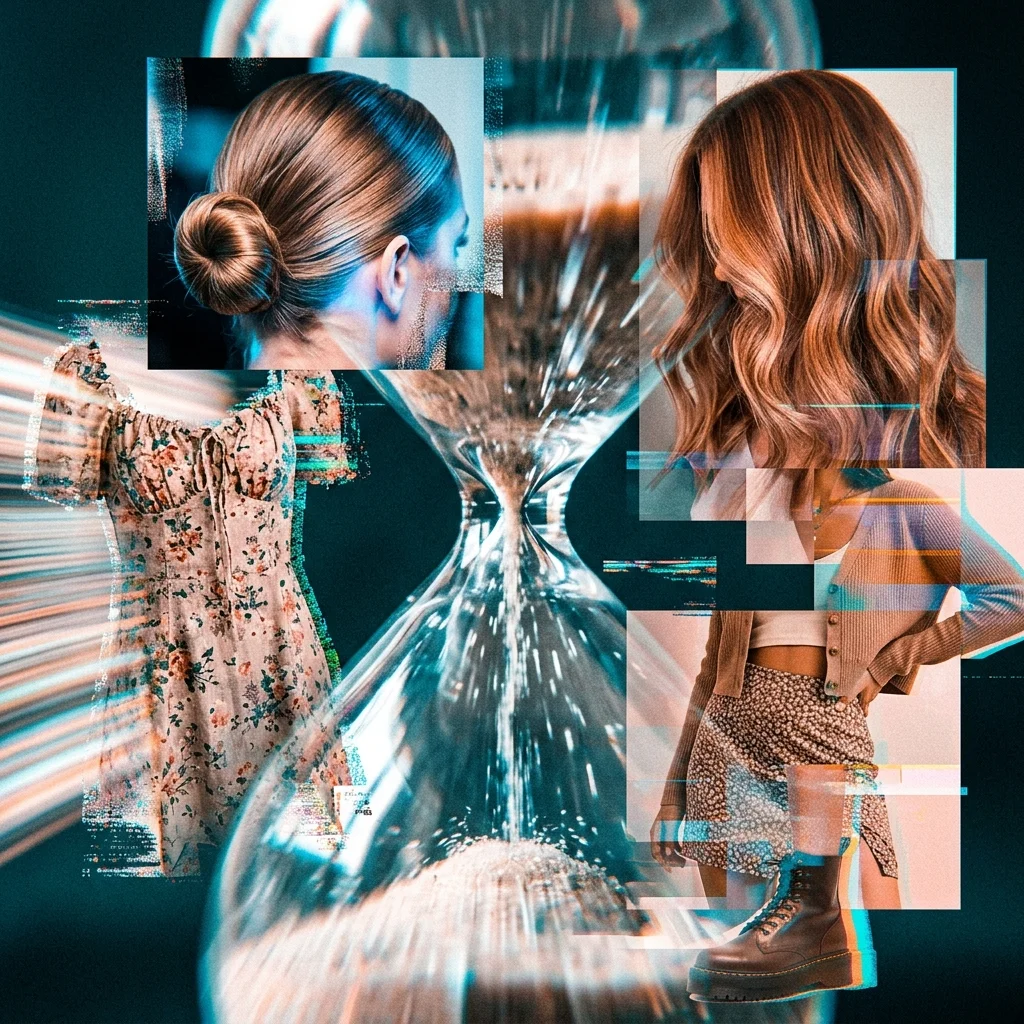
The Ephem-Era: How Micro Trends Are Reshaping Fashion's Economy and Culture
The Ephem-Era: How Micro Trends Are Reshaping Fashion's Economy and Culture
Introduction: The Age of Instant Trends
In the summer of 2023, a single video on TikTok featuring a user wearing a floral midi dress with chunky loafers amassed 12 million views in 48 hours. Within a week, fast-fashion retailers had duplicated the look, and by the end of the month, the style—dubbed “cottagecore 2.0”—was already being declared “out” on comment threads. This is not an anomaly; it is the new normal.
Micro trends, defined by TrendBible as “a niche or industry-specific consumer behavioral trend… with a shorter life span, usually filtering down from Macro Trends,” have become the dominant force in fashion. Unlike the seasonal rhythms that governed the industry for a century—Spring/Summer, Fall/Winter, with occasional mid-season drops—today’s trend cycle operates on a daily, sometimes hourly, basis. The engine is social media algorithms, which reward novelty and punish repetition. The result: a system in which a style can be born, peak, and die before a traditional fashion house finishes its production cycle.
This acceleration creates a central tension. On one hand, micro trends democratize style: anyone with a phone can spark a movement, and niche aesthetics—from “cinnamon cookie butter hair” to “clean girl” minimalism—find global audiences overnight. On the other hand, the constant churn of “newness” fuels overconsumption, strains supply chains, and hollows out the cultural depth that once distinguished authentic subcultures. This article unpacks the economic and social logic behind micro trends, drawing on industry reports, expert definitions, and critical voices to argue that fashion is undergoing a structural transformation with profound implications for everyone involved.
[IMAGE: A split image showing a traditional fashion calendar on one side (four seasons with exact dates) and a rapidly spinning TikTok feed on the other, with trend labels flickering past like “Brat Summer,” “Mob Wife,” “Clean Girl,” and “Coastal Grandmother.”]
The Engine: Social Media and Algorithmic Trend Propagation
The speed of micro trends is not accidental—it is engineered. Platforms like TikTok and Instagram Reels are built on recommendation algorithms that prioritize engagement over all else. When a user posts a video wearing a certain silhouette or using a specific makeup filter, the algorithm tests it on small groups. If the watch time and shares exceed thresholds, the content is pushed to exponentially larger audiences. A style that might have taken months to trickle down from runway to high street now reaches mass awareness within days.
“A perfect (and troubling, for the environment) mixture of the need to satiate our feeds with ‘newness’ coupled with access to a never-ending vault of nostalgia,” writes fashion commentator Natalia Christina, describing the mechanism. The “never-ending vault” is key: algorithms mine past decades—90s slip dresses, 2000s low-rise jeans, 80s power shoulders—and remix them into “new” looks. This recycling creates the illusion of originality while actually accelerating consumption because each revival feels fresh to younger audiences who never experienced it the first time.
The agency Day One has coined the term “Ephem-era” to describe this phenomenon. Their report notes that by the time a consumer discovers a trend and decides to purchase an item, the trend has often already peaked and is being replaced. This “fickle community” dynamic means that brands cannot rely on the old model of building long-term loyalty around a seasonal aesthetic. Instead, they must treat every product drop as a temporary event with a shelf life measured in weeks, sometimes days.
[IMAGE: A diagram of a trend lifecycle on TikTok: a small spark labeled “User Post,” an exponential curve pointing to a peak marked “Viral (3 days),” followed by a steep decline labeled “Replaced by Next Trend.” Arrows show algorithm amplification at each stage.]
The economic implications are stark. Traditional fashion calendars operated on 6–12 month lead times. Designers planned collections, factories ordered fabrics in bulk, and retailers placed orders months in advance. Micro trends upend this logic. To capitalize on a viral moment, brands must be able to go from concept to store shelf in under two weeks. This has given rise to a new breed of “rapid responders”: companies that use AI trend forecasting, on-demand manufacturing, and local production to shorten cycle times. Zara, long the gold standard of fast fashion, now claims a turnaround of 10–15 days for some items. But even that pace is being challenged by newer entrants like Shein, which can test thousands of new styles daily, with production runs as small as a few hundred units.
The Economic Logic: Speed, Disposability, and Overconsumption
The demand for constant novelty is not a consumer preference freely chosen; it is a structural requirement of the algorithm-driven attention economy. If a brand does not offer something new every few days, its content drops in the algorithm, its online store traffic declines, and its sales suffer. This creates a feedback loop: brands push out more product lines; consumers are bombarded with more choices; the rate of trend obsolescence increases; and the only way to keep up is to buy more.
The environmental cost is staggering. According to a 2023 report from the Ellen MacArthur Foundation, global textile production has doubled since 2000 and is projected to triple by 2050 if current trends continue. Micro trends exacerbate this by shortening the usable life of garments. A study by the clothing resale platform ThredUp found that the average American now wears an item only seven times before discarding it. When trends rotate every few weeks, the impulse to throw out “outdated” clothes intensifies. Landfills receive 92 million tons of textile waste annually, much of it synthetic fibers that do not biodegrade.
Day One Agency’s report on the Ephem-era highlights another hidden cost: supply chain disruption. Traditional retailers plan inventory months ahead and rely on large, predictable orders to negotiate lower unit costs. Micro trends require flexibility—small batches, rapid reordering, and the ability to kill a product line overnight. This forces manufacturers to operate with excess capacity and higher per-unit costs, which are passed on to consumers or absorbed through thinner margins. For smaller brands, the volatility can be fatal. “One minute you have a viral hit, and the next you’re stuck with 10,000 units of a style no one wants,” a mid-sized brand owner told Business of Fashion in a 2024 interview. The result is a squeeze on the middle market: either you operate at Shein’s hyper-efficient scale or you serve a tiny niche with handmade, sustainable goods. The traditional “affordable luxury” segment is disappearing.
[IMAGE: A photo of a crowded clothing rack in a warehouse with tags marked “Sold out in 3 days” alongside a background of discarded garments piled in a landfill. The contrast between the new-tag and the waste is stark.]
The Social Cost: Exclusion and the Loss of Authentic Subculture
Beyond the economic and environmental toll, micro trends carry a less visible but equally significant social cost: the erosion of authentic subcultural identity. Traditional subcultures—punk, goth, grunge, rave—were rooted in shared values, musical scenes, and political stances. Their aesthetics emerged organically from communities of practice: the safety pins and leather jackets of punk signaled rebellion against consumerism; the black lace and fishnets of goth expressed a romantic embrace of the macabre. These were not looks to be purchased and discarded; they were badges of belonging.
Micro trends invert this logic. A “clean girl” aesthetic—slicked-back bun, minimalist makeup, neutral-toned athleisure—can be adopted by anyone, anywhere, with a single shopping trip. There is no subcultural gatekeeping, no need to know the history or the music. But this openness comes at a price: the trend becomes a hollow signifier. As cultural critics have noted, the “clean girl” look, in particular, has been criticized for promoting exclusionary standards of beauty—thin, white, and polished—masked as “effortless” wellness. The aesthetic’s rise on TikTok coincided with a surge in “that girl” content, which prescribes rigid routines of 5 a.m. wake-ups, green smoothies, and expensive skincare. The subtext, many argue, is a narrow, class-bound ideal that judges those who cannot afford or do not desire this lifestyle.
The problem, as observers point out, is that micro trends often strip away the very elements that gave older subcultures their resilience. A punk jacket might be kept for years, reworked with patches and pins; a cottagecore dress might be worn to exhaustion. But a “clean girl” outfit—often cheaply made polyester blends from fast-fashion sites—loses its appeal the moment the next trend arrives: “mob wife,” “Brat summer,” “goblin core.” The cyclical churn encourages disposability, not identity.
[IMAGE: A side-by-side comparison: on the left, a group of punks in the 1980s with hand-distressed jackets and band patches, clearly part of a scene; on the right, a solo TikTok creator posing in a perfectly packaged “clean girl” outfit with a sterile background. The caption overlaid: “Adopted, not lived.”]
Moreover, the algorithmic nature of trend propagation means that micro trends can flatten regional and cultural differences. A style that originates in Tokyo street fashion can be co-opted by a global influencer before the Japanese subculture itself has had time to develop meaning. The result is a kind of cultural extraction: the aesthetic is consumed, the context discarded. As one fashion historian wrote, “When everyone is a punk for a week, no one is a punk.”
The Threat to Innovation
The relentless acceleration also threatens fashion’s innovation patterns. When brands must produce new micro trends every week, they rely on two strategies: recycling past decades and copying viral one-offs. True design innovation—the kind that emerges from research, material experimentation, and artistic risk—takes time. The current system penalizes that time. A designer who spends six months developing a new fabric treatment risks seeing their work imitated by fast-fashion replicators before it even hits stores.
This dynamic has led to a homogenization of the market. Despite the appearance of endless variety, most micro trends are remixes of a limited set of shapes (oversized blazers, wide-leg trousers, crop tops) and colors (beige, burgundy, electric blue). The “newness” is often superficial: a slight change in sleeve length, a different neckline. The underlying garment architecture remains unchanged. This is not a recipe for creative growth; it is a recipe for stylistic stagnation disguised as churn.
Conclusion: Toward Intentional Trend Creation
Micro trends are not likely to disappear—they are too deeply embedded in the economic and social dynamics of digital platforms. But recognizing their mechanics is the first step toward a more intentional approach. For consumers, this means resisting the urgency of the algorithm and asking whether a purchase reflects a genuine personal style or a temporary algorithmic push. For brands, it means resisting the race to the bottom in production speed and instead building lasting value through better quality, storytelling, and customer relationships.
Some designers are already experimenting with “slow trend” models: releasing limited-edition capsules that are designed to be worn for years, not weeks, and investing in educational content that contextualizes the aesthetic within a broader cultural narrative. Others are embracing circularity—rental, resale, repair—as a counterweight to disposability. The fashion industry, for all its flaws, has historically been a site of cultural conversation. The challenge of the Ephem-era is whether that conversation can survive on a platform that demands a new sentence every second.
The answer lies not in rejecting speed entirely, but in using it consciously. When a micro trend emerges, we can pause and ask: Does this add something meaningful, or is it just another grain of sand slipping through the hourglass? The hourglass, after all, is not infinite.
[IMAGE: An artistic collage of fading fashion trend icons—a cottagecore dress, a clean girl slicked-back bun, cinnamon cookie butter hair, and a “core” outfit—superimposed over a blurred hourglass with sand pouring rapidly. The image conveys speed, disposability, and digital saturation. No text or watermarks.]